
I’ve been diving deep into the wisdom of Joseph Campbell lately, and his framework for understanding the four functions of mythology has really got me thinking about how we all create the worlds we live in.
As someone who spent three decades as a leadership consultant and executive coach, helping leaders shape and reshape organizational cultures, Campbell’s insights feel surprisingly relevant to my current adventure: being back at school, joyfully rediscovering the art of drawing – my goal is to retrain my eyes, to learn to see the world differently.
My journey back to the art studio has been incredible, and I’m genuinely grateful for the opportunity to learn and grow in this new environment. This school is a very special space.
Even as I am focused on my goal, my years spent observing the intricate dance of human interaction within companies have instilled in me a natural curiosity about the underlying dynamics at play, even here.
What’s particularly striking about my school is its incredibly strong culture. It’s palpable. In my professional career, I have rarely experienced a culture so well-constructed. Walking the halls, you’re met with visual declarations of their core “method” – examples of what “good” looks like framed on the walls.
Here’s where Campbell’s idea of the cosmological function starts to click for me. These images feel like a visual creation myth, laying out the accepted order of things, the “how the world works” within these studio walls. Interestingly, the uniformity in these examples is so pronounced that they almost appear to be the work of a single hand – icons of a very specific artistic reality.
Then there’s the language. The way authority figures, our teachers, communicate is remarkably consistent. It’s as if they’re all speaking from the same well-crafted script. This resonates with Campbell’s sociological function. Just as ancient myths reinforced social norms and hierarchies, the shared language here seems to solidify the school’s values and expected ways of operating. There’s a strong sense of what’s “in” and what’s “out,” and the consistent messaging reinforces this social cohesion.
The pedagogical aspect is also fascinating. Campbell described how myths guide individuals through life and teach cultural norms. Here, the constant visual reminders of the “method” and the didactic nature of critiques – focusing intensely on mistakes and corrections – feel like a very specific form of instruction. It’s a clear pathway laid out, a “this is how you navigate this world” message being consistently delivered.
Now, let’s talk about the mystical function. This is where mythology evokes a sense of awe and wonder, connecting us to something larger than ourselves. In many traditional myths, this is achieved through stories of gods, creation, and the mysteries of life and death. Think of the awe-inspiring narratives of the cosmos in various creation myths or the profound sense of connection to nature in indigenous stories. Campbell often spoke of this as the experience of recognizing the “mystery of being” that underlies all existence.
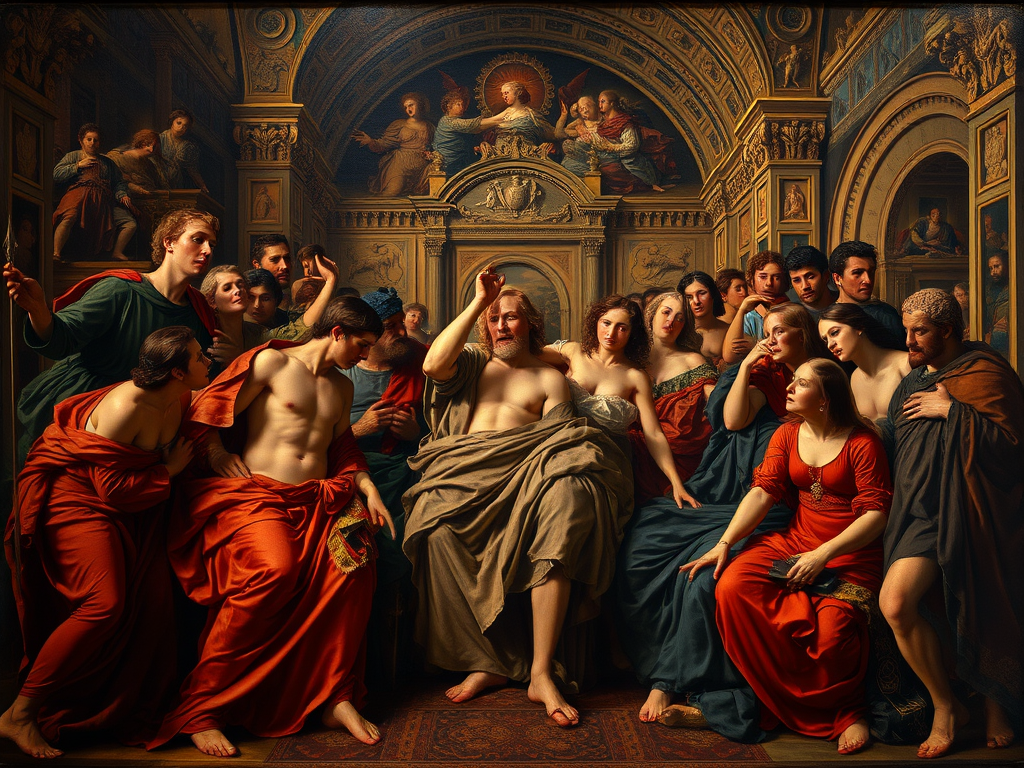
In the context of my art school, this mystical function is present, and significantly shaped by the school’s reverence for the Renaissance, and old masters like Michelangelo, Donatello, Rembrandt, Caravaggio, and Ingres aren’t just historical figures; they’re elevated to the status of artistic heroes, almost demigods, within this culture. Their works and techniques are held in the highest esteem, representing the pinnacle of artistic achievement. This creates a sense of awe and reverence around their artistic legacy, and by extension, the school’s “method” which is seen as the way to access that legacy.
Students may feel a sense of being part of something larger than themselves, initiated into a lineage of artists who have followed this path, striving to emulate these “masters”. The studio itself, dedicated to this particular approach and these artistic ideals, can become a kind of sacred space, set apart from the ordinary world, where students seek to connect with this artistic transcendence. One of my student colleagues described his experience as profoundly life-changing, akin to being in a monastery.
This isn’t to say the school is intentionally creating a religion, but rather that any system that demands such complete devotion and offers a path to a highly valued ideal, especially when embodied by revered figures, can take on this mystical dimension.
My background as a leadership coach makes me particularly sensitive to the nuances of this environment. While I deeply value tenacity in pursuing artistic growth and find joy in the learning process, my inherent openness and belief in the power of diverse perspectives sometimes feel… challenged. There’s a strong commitment to the school’s goals, which is admirable, but I’ve noticed a limited tolerance for debate or inquiry that doesn’t neatly align with their established worldview. It’s as if the narrative is so potent that alternative viewpoints struggle to find space.
This brings me to Campbell’s powerful idea that “man is the creator” of myth. Just as ancient societies crafted narratives to understand their world, the leaders of this school have, consciously or unconsciously, built a very potent cultural narrative. They have actively shaped the environment, the visuals, and the language to reflect their vision of artistic excellence.
Having spent years helping corporate leaders understand and sometimes reshape their own organizational “myths,” I can see the parallels so clearly.
Organizations, like societies, create their own stories, their own ways of understanding and operating. And while a strong culture can be a powerful driver of success, as it seems to be here, it also invites reflection. How much space is there for individual interpretation and the unique creative voice that I, and I’m sure many others, are striving to cultivate?
My intention isn’t to critique this school – I am genuinely grateful to be here. Instead, fueled by my values of creativity, tenacity, compassion, openness, and joy, I’m using my experience as a lens, a real-world example of how the ancient functions of mythology play out in our modern “tribes,” whether they be companies or educational institutions.
By observing these dynamics through Campbell’s framework, perhaps we can all gain a deeper understanding of the invisible forces shaping our own environments and the stories we collectively create and inhabit.
It makes me wonder, in our own “corporate pantheons” or even our artistic journeys;
- how consciously are we crafting our narratives, and
- how much space are we leaving for the beautiful, messy, and vital contributions of individual perspectives?
 Tim Taylor
Leave a comment