On rushing, letting go, and making peace with the way I’m made
In my last post I wrote about a morning coffee with Maui, the small, unremarkable ritual that turned out to be where peace actually lives. This is a follow-on, because something has shifted since then, and I want to try to name it before it becomes so ordinary that I stop noticing it.
I feel more at peace these past few months than I have in years. And when I ask myself why, the first answer that comes back has nothing to do with painting. It’s about my house.
Making peace with the house
The house has problems. The builder didn’t do everything he was supposed to do; in truth, he didn’t finish it. That was disappointing, and I felt let down. But I’ve come to see that the disappointment was never the heaviest part. The heaviest part was what I did with it: a long, private trial in which I was both prosecutor and defendant. Too stupid, too weak, too trusting, too this, too that. Never enough of whatever it would have taken to make him do the right thing.
There was no version of me that could have made him do the right thing. He is what he is. He was almost exactly what I suspected on the first day I met him. The Italians have a word for it, and it isn’t polite. He was not a man of his word. Some people aren’t. You can spend your life demanding that they be, or you can recognise that they aren’t, and put the demand down.
Epictetus opens his Enchiridion with the line on which the whole of Stoicism rests: “Some things are within our power, while others are not.” Another man’s integrity was never within my power. My response to its absence always was. Two thousand years on, that distinction still does exactly what it was designed to do: it hands your energy back to you.
So I have a plan. Fix what needs fixing, put right what needs putting right, and in doing so get the things I actually want from this house: a terrace I’ll love, a guest bedroom so my children can come and stay, and a tiled ground floor so the dust stops settling on everything, every single day. The house hasn’t changed yet. My relationship with it has.
What was I rushing for?
The other day I was in Lecce when a message came in from a friend: did I want to go for a walk and a picnic? Yes, of course. And then I drove home so fast that the soft top of my Suzuki Jimny blew back. Not off, thankfully, but with a crack that sounded like something had broken. I looked round and the whole roof had folded back, the car open to the sky.
It took a moment to see what had happened. Both front windows were down, the air was tearing through the car, and all of it was funnelling into that little bubble of plastic and canvas at the back. Of course it gave way. So I had to stop rushing in order to repair the consequences of rushing. And when I finally got home with my groceries, my friends weren’t going to be ready for another hour.
What was I rushing for? I hadn’t paused for a single second to ask what the timescale actually was. I had simply assumed, as I suspect I’ve assumed for most of my life, that the right speed is flat out.
A picnic by the sea
Then we walked. They’d invited a few others, most of whom I knew and one I didn’t, and we walked the beach at Spiaggia del Frascone, with Maui and Benny running ahead, Maui in and out of the water, frolicking the way only a dog can. We stopped to eat. I had some sushi I’d picked up; they’d brought cheese and French sausage. And Rajeev simply said, out loud, how wonderful the day was. How warm it was, and how there we were, sitting by the sea with the freshness coming off the water.
It was a small act, naming the day. But it stayed with me. We were in the privileged position of being able to spend an afternoon exactly like that, and the moment itself, unadorned, was peace. Not a reward for something. Not a pause before the next thing. Just the thing. It’s hard to explain to people that this is what a day can look like. I’m still learning to explain it to myself.
The mind that won’t sit still
And yet. That same week I found myself in a meeting with two others and realised, with a jolt: I’m in another startup. This alongside a handful of other projects that have quietly sprung up, work of the kind I used to do, but which I now want to do on entirely different terms. Not to feed the bills. To do work worth doing, and to be compensated and recognised in ways that actually suit me.
My first reaction was: am I mad? Haven’t I just been writing about peace?
Pascal observed that all of humanity’s troubles come from our inability to sit quietly in a room alone. For years I would have read that as a diagnosis of me. I can’t sit still. My mind is extraordinarily active, and I spent a long time treating that as a flaw to be managed.
But here is what I’m beginning to understand. For me, peace isn’t stillness. Peace is letting my mind do what it does without fighting it, almost as if I’m watching it rather than wrestling it. It’s acknowledging my nature. This is how I function. It isn’t a problem. It’s simply me.
Restless, though, is not the same as scattered. When something has my attention, it has all of it. As a child, my mother would have to call me several times, not because I was ignoring her but because, as she put it, I was in my own world and had shut out everything and everyone. People have sometimes read that same focus as bluntness, or as a lack of interest in them. It’s neither. When I paint, or sit over one of my small drawings, the same thing happens: I’m lost from this world and gone into another. The mind that leaps between a dozen things is the same mind that, once it lands, goes all the way down.
The poet Pindar put it more economically, twenty-five centuries ago: “Become what you are, having learned what that is.” Nietzsche later adopted the line as something close to a personal motto. The weight falls on the middle clause: having learned. You can’t become what you are until you’ve stopped arguing with the evidence.
Four or five canvases at once
The evidence, it turns out, was there all along. At college I always had four or five paintings on the go at once. When I facilitate, the bigger the group, the more fun I have, because there are more inputs. I draw energy from all of it, and when it’s over I’m exhausted. Spent, but spent in the best possible way.
In the studio I have here, I’ve been working on one canvas at a time. It doesn’t work. It doesn’t push me, and it doesn’t push the paintings.
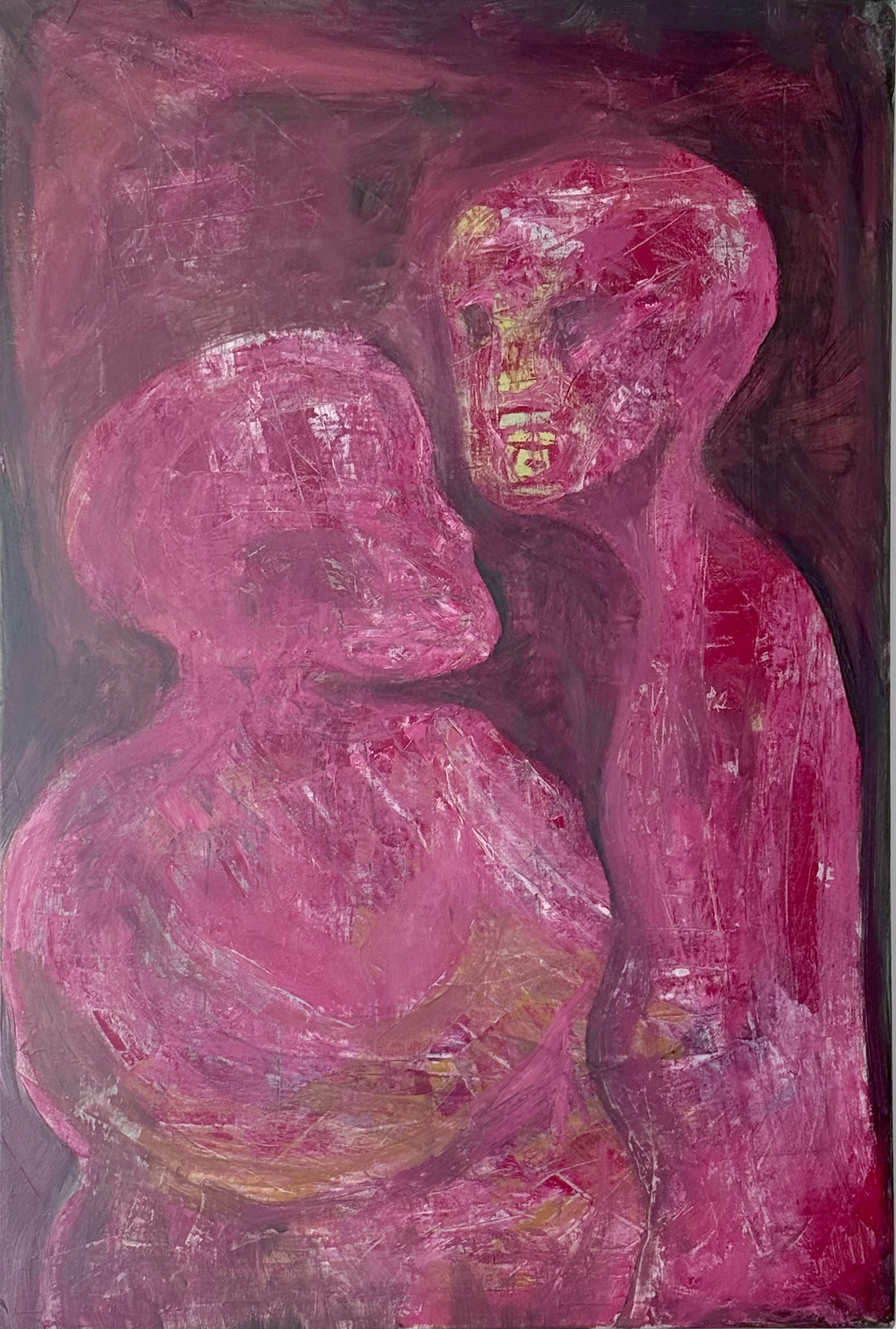
So I’ve taken everything off the walls, stacked it, and put up just three: Being, the pink one; Léeza, the painting of my sister; and Absence, the one with the chair. Léeza is finished. It’s beautiful, and I don’t need to touch it again. The other two need more, and Absence in particular has more in it yet. But they’ll find their way in a studio where I can see them side by side and move between them.
Which is why I’m going to see a new studio this week, in a town about fifteen minutes away by car, or forty by bike, which is how I want to get there come summer. Room for more than one canvas. Room for the way I actually work.
Who I am is not bad
If I’m honest, what I’m describing is less a set of decisions than a discovery. I’m getting to know myself, and trying to make peace with who I find. And who I am is not bad.
Did I always think it was? I’m not sure. But I suspect I spent a long time compensating, trying to be whatever someone else needed me to be: steadier, tidier, easier to read, less lost in my own world, more like the man in Pascal’s quiet room. That effort had a cost I didn’t see until I stopped paying it.
The house is still unfinished. The canvases are still unfinished. I’m unfinished. But I’m no longer at war with any of it, and that, I’m learning, is what peace looks like for an artist who can’t sit still.